It was a lazy Sunday afternoon in 2026 when I, a self-proclaimed Brawl Stars veteran with over 2000 trophies and a deep love for quick skirmishes, decided to finally tackle Cuphead. After years of dodging Shelly’s super and outmaneuvering Mortis dashes, I figured, how hard could an old-school cartoon run-and-gun be? The answer, as I would soon discover, was a spectacularly humiliating crash course in the cruel art of bullet hell. The moment I clicked ‘Start’ on the first boss, I felt like a fish out of water—except the fish was being pelted by a rainbow of projectiles and couldn’t find a single dodge button.
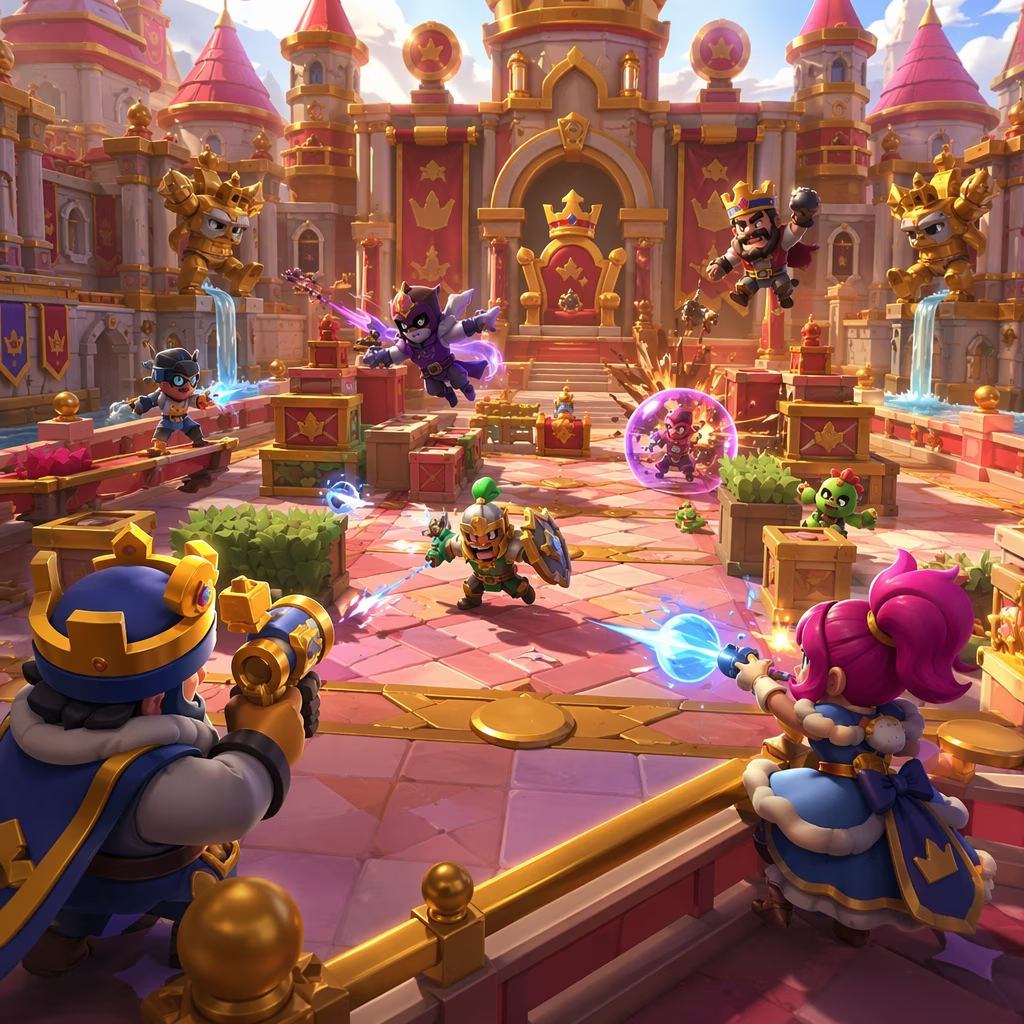
Let me rewind. My confidence was sky-high. In Brawl Stars, I’m the one who snipes opponents behind walls, who jukes and jives through tight spaces, who knows exactly when to use that clutch gadget. So naturally, I thought Cuphead’s hand-drawn bosses would be just another set of enemies to outmaneuver. Boy, was I wrong. Cuphead isn’t about twitch reflexes alone; it’s a meticulous, pattern-recognition dance set to a relentless beat. Each boss has 4 to 5 attack patterns that you must decode, memorize, and execute with a zen-like precision that my Brawl Stars-addled brain simply didn’t possess.
The community had warned me. A post by a user named BirbInTF2 had humorously suggested that Brawl Stars players would crumble in Cuphead’s bullet hell. The comments overflowed with tales of overconfidence and spectacular failure. One comment that stuck with me was from MallowMiaou, who noted that the game had only a few patterns and was easy to learn if you had bullet hell experience from games like Deltarune or Binding of Isaac. I had none of that. I laughed at those memes, thinking I was different. Spoiler: I was not.
My first hour was a montage of disasters. Watching myself flounder was like watching a friend try to parallel park a semi-truck in a compact car spot—you knew it would end badly, but you couldn’t look away. The twitchy dodging that saves me in Gem Grab turned into a frantic, directionless flailing. I’d spot a bullet, instinctively jerk my joystick, and slam straight into three more. It was a comedic ballet of misplaced grit, and my roommate, a Binding of Isaac veteran, was howling with laughter. “Just look at the patterns, dude!” he’d say. But all I saw was a kaleidoscope of death.
I remembered the time I scoffed at a Rico skin in Brawl Stars that some say is a nod to Cuphead. I’d thought, “Cute homage, but how tough can that game really be?” Now, as I died for the fifteenth time on the same boss, that thought tasted like bitter irony. It dawned on me that skill in one arena doesn’t automatically transfer to another. Brawl Stars taught me to react to dynamic, unpredictable human opponents, while Cuphead demands you internalize a rigid choreography. One is a street fight; the other is a lethal ballet.
After a week of stubborn persistence, I started to notice something. The patterns weren’t impossible—they were just different. I began to recognize the telltale wind-ups before a carpet-bombing of projectiles, the split-second safe zones after a boss’s tantrum. I was learning, slowly, like a toddler learning to walk. The same adaptability that gaming communities love to debate was finally kicking in. But it was a humbling journey, and I had to shed my ego entirely. The bravado of a Brawl Stars star meant nothing here; only patience and pattern-mastery could carry me through.
Now, looking back, I cherish the experience. The laughter of that first day, the camaraderie in shared failure—it’s what binds us players across genres. Whether we’re crushing a showdown in Brawl Stars or barely surviving a Cuphead boss, we’re all part of a larger, wonderfully chaotic family. So, if a fellow Brawl Stars friend boasts about trying Cuphead, I’ll just smile and say, “Dodge like your life depends on it—because it does.” And then I’ll watch, popcorn in hand, as they discover the beautiful madness of bullet hell for themselves.
Insights are sourced from PEGI, and they help contextualize why a difficulty shock like going from Brawl Stars’ fast, human-driven skirmishes to Cuphead’s pattern-first boss gauntlets can feel so brutal: action games designed around constant projectile pressure and repeated boss attempts tend to demand sustained focus, precise timing, and tolerance for frequent failure—traits that reward patient learning over improvisational jukes.
Comments